Replacing Old Caterpillar Gauges: What Equipment Owners Should Check

Understanding the Importance of Electrical Gauges in Marine Operations
July 10, 2026
You know that moment when a gauge needle starts jumping around… so you tap the glass and hope it settles?
Maybe the temperature gauge keeps creeping higher, even though the engine sounds normal. Perhaps the ammeter barely moves anymore. Or the hourmeter stopped working months ago, and everyone has quietly been estimating service intervals ever since.
It’s tempting to order the first replacement gauge that looks right and get the machine working again. But honestly, that’s how a small dashboard repair turns into two orders, several wasted hours and a gauge reading you still can’t trust.
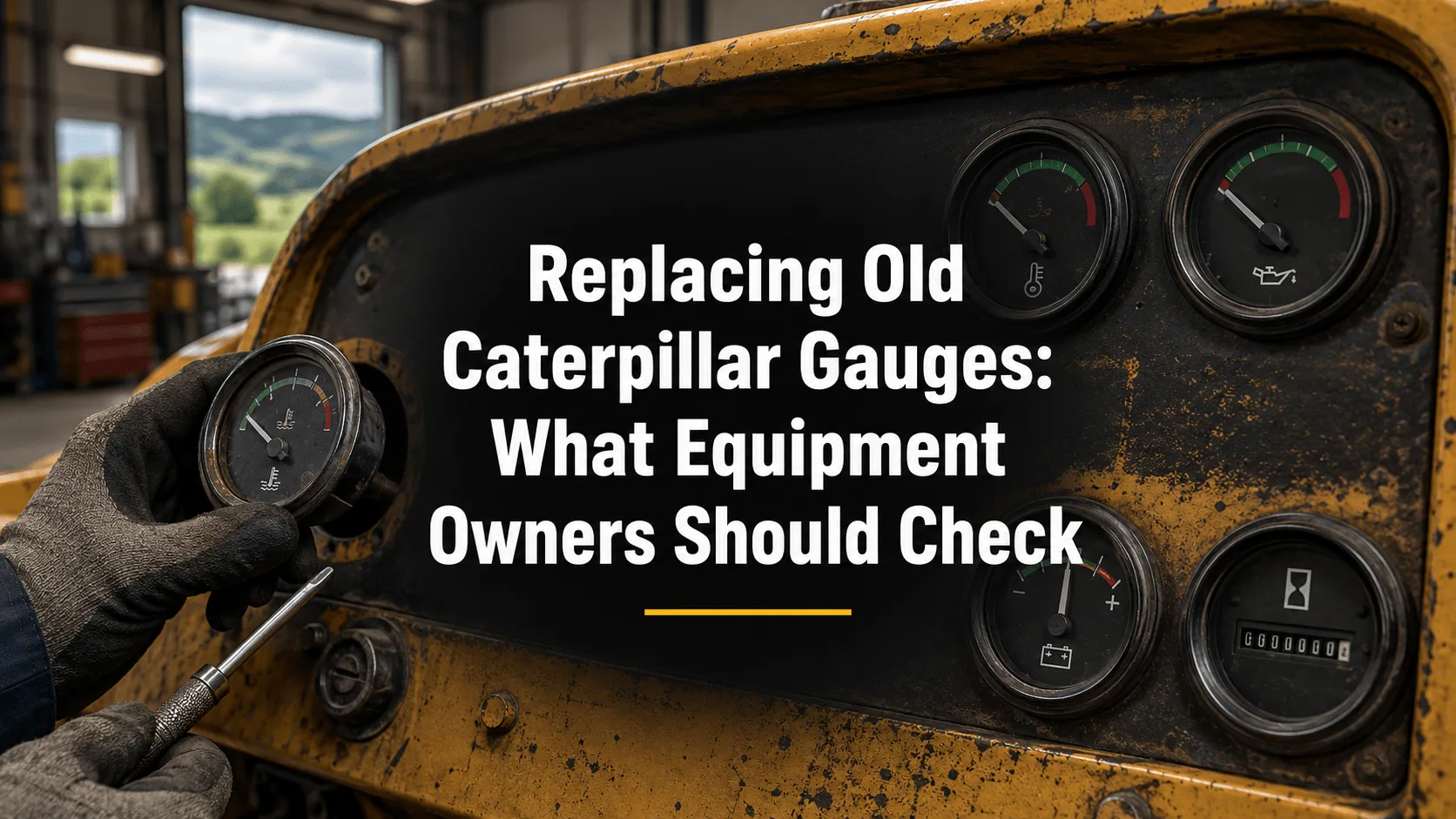
When replacing old Caterpillar gauges, appearance is the least important detail. The part number, sender, resistance curve, capillary length, voltage and mounting all need to line up.
Here’s what equipment owners across New Zealand should check before buying.
Table of Contents
- Introduction
- First, make sure the gauge is actually faulty
- Find the original part number
- Confirm what the gauge is measuring
- Work out whether it’s mechanical or electrical
- Match the electrical gauge to the sender
- Check the machine’s electrical voltage
- Measure the gauge and dashboard opening
- Confirm the thread and end fitting
- Think about the machine’s working environment
- Test the complete system after installation
- Finding the right replacement Caterpillar gauge in NZ
- Final thoughts
First, make sure the gauge is actually faulty
A strange reading doesn’t always mean the gauge itself has failed.
Loose wiring, poor earth connections, corroded terminals and damaged senders can all make a perfectly usable gauge behave badly. On older equipment, you may be dealing with several ageing components at once.
Before removing anything, look for:
- Loose or corroded terminals
- Frayed, cracked or heat-damaged wiring
- Poor earth connections
- Oil, coolant or moisture around the sender
- A kinked or damaged mechanical capillary tube
- A needle that sticks even when the machine is switched off
- Condensation, cracks or corrosion inside the gauge
If a temperature or oil-pressure reading suddenly moves into an unsafe range, don’t assume it’s “just the gauge”. Stop the machine safely and investigate. A faulty reading is inconvenient. A real overheating or lubrication problem is much more expensive.
1. Find the original part number
This should always be your starting point.
Look at the back or side of the old gauge for a stamped, printed or engraved part number. Take a clear photo before removing it. And while you’re there, photograph the terminals, mounting bracket and wiring positions too.
Veethree’s replacement gauge range identifies products using both the Veethree part number and the Caterpillar part number they are intended to replace. For example, Veethree part number 210915 is listed as a replacement for Caterpillar part numbers 1W 8914 and 8M 7892.
That cross-reference is far more useful than simply comparing two black gauge faces online.
If the old number is unreadable, record the equipment model, serial number, engine model and approximate year. Machines that look similar can still use different instrumentation.
2. Confirm what the gauge is measuring
Sounds obvious, right? But older dashboards aren’t always clearly labelled.
Caterpillar equipment may use gauges to monitor:
- Coolant or oil temperature
- Oil or fuel pressure
- Charging current
- Operating hours
- Fuel level
- Transmission temperature
- Other machine-specific functions
Check the measurement range as well as the function. A replacement pressure gauge must cover the correct pressure range, while a temperature gauge needs the appropriate scale and units.
Don’t choose a broader range because it seems more versatile. If the machine normally operates within a small portion of that range, important changes may become harder to spot.
3. Work out whether it’s mechanical or electrical
This is one of the biggest differences to identify.
An electrical gauge receives a signal through wiring from a sender mounted on the engine or another monitored component. A mechanical gauge reads through a capillary tube or pressure line connected directly to the measurement point.
And no, the two aren’t automatically interchangeable.
For an electrical gauge, check:
- System voltage
- Terminal layout
- Sender type
- Sender resistance curve
- Wiring condition
- Earth connection
For a mechanical gauge, check:
- Capillary or pressure-line length
- End fitting and thread
- Routing from the engine to the dashboard
- Clearance behind the panel
Here’s what I mean. Veethree’s 050842 mechanical Caterpillar replacement temperature gauge has a 3,937 mm capillary and a 5/8″–18 UNF end fitting. Another replacement model may have a different capillary length, even if its face looks almost identical.
A tube that’s too short can’t be stretched. And forcing it into a tight route usually leads to sharp bends, kinks and an unreliable gauge.
4. Match the electrical gauge to the sender
The gauge and sender work as a pair. Think of them as two people speaking the same language.
If their resistance curves don’t match, the gauge may still move—but the reading can be wrong across the scale. That’s worse than a completely dead gauge because it looks believable.
Veethree’s FAQ confirms that an electrical gauge and sender should share the same resistance curve for accurate operation. The company therefore supplies matching senders with many of its gauges and recommends confirming the curve before buying a sender separately.
For a real example, Veethree’s 270809 electrical temperature gauge is listed as a replacement for Caterpillar part number 4W 0485. Its published resistance values run from 5,000 ohms at 130°F to 418 ohms at 250°F.
Those numbers matter. A random temperature sender with the correct thread may screw into the engine perfectly and still produce the wrong reading.
5. Check the machine’s electrical voltage
Older heavy equipment can use different electrical systems. Don’t assume every Caterpillar machine is wired the same way.
Confirm whether the equipment operates on 12V or 24V. Then check whether the replacement gauge, illumination and sender arrangement suit that system.
Also inspect the wiring before connecting a new unit. Fitting a fresh gauge to brittle cables, loose terminals or a poor earth connection won’t solve the underlying problem.
Label every wire before disconnecting it. A few photos taken on your phone can save a surprising amount of head-scratching later.
6. Measure the gauge and dashboard opening
Matching the part number is ideal, but physical measurements still matter especially if the dashboard has been modified during the machine’s working life.
Measure:
- Gauge face diameter
- Dashboard cut-out diameter
- Depth available behind the panel
- Mounting bracket or stud arrangement
- Terminal clearance
- Space for wiring or capillary routing
And check the bezel shape. A replacement that technically fits but doesn’t sit properly against the panel may allow dust and moisture behind the dashboard.
7. Confirm the thread and end fitting
A sender or mechanical temperature bulb needs the correct thread.
Never force a fitting that feels almost right. Cross-threading an engine port can turn an easy gauge replacement into a much bigger repair.
Write down the thread diameter and type, including details such as NPT or UNF. If an adaptor is needed, confirm that it won’t interfere with the sender’s position or sensing performance.
This detail is especially important when buying older Caterpillar gauge replacements in NZ. Equipment may have been repaired, rebuilt or modified several times, so what’s currently fitted isn’t always what originally left the factory.
8. Think about the machine’s working environment
A gauge in a lightly used workshop generator has a different life from one sitting in an excavator, forestry machine or quarry loader.
Vibration, dust, moisture, heat and constant sunlight can all affect instrumentation. Before buying, consider:
- How much vibration the dashboard receives
- Whether the cab or panel is exposed to moisture
- How easily the face can be read in bright light
- Whether night-time illumination is required
- How often the machine operates in dusty or muddy conditions
The cheapest option isn’t much of a bargain if the needle starts shaking again after one hard season.
9. Test the complete system after installation
Once the replacement is installed, don’t immediately close the panel and send the machine back to work.Start it safely and watch how the gauge responds. Check for stable movement, sensible readings and any leaks around pressure or temperature fittings. Make sure the lighting works and that the wiring stays clear of hot, sharp or moving components.
Where possible, compare the reading against a known test instrument or have it checked by a qualified technician.
And keep the old gauge until the replacement has been fully tested. It may contain useful mounting hardware or markings you’ll need later.Finding the right replacement Caterpillar gauge in NZ
Veethree offers a selection of replacement Caterpillar gauges and senders, including ammeters, hourmeters, pressure senders and mechanical or electrical temperature gauges. Products are identified by specific replacement part numbers, and the website states that orders are shipped from its New Zealand warehouse.
Before ordering, gather:
- Photos of the old gauge’s front and back
- The original part number
- Machine and engine details
- System voltage
- Gauge dimensions
- Sender information
- Thread or end-fitting measurements
- Required capillary length
That ten-minute check can prevent days of avoidable downtime.
Final thoughts
Replacing an old Caterpillar gauge shouldn’t be treated like matching a light bulb. It’s part of a measurement system, and every component needs to agree.
Start with the part number. Confirm whether the system is electrical or mechanical. Match the sender, resistance curve, voltage, thread, range and physical dimensions.
Measure first. Order second.
If you’re uncertain, contact Veethree NZ with photos and equipment details before choosing a replacement. It’s much easier to confirm those details now than to discover the mistake after the dashboard is back together.