How Salt, Moisture, and Corrosion Affect Electrical Gauge Accuracy

12V vs 24V Electrical Gauges: How to Avoid Expensive Mismatches
May 28, 2026
How Marine Gauges Contribute to Safe and Efficient Boating
June 26, 2026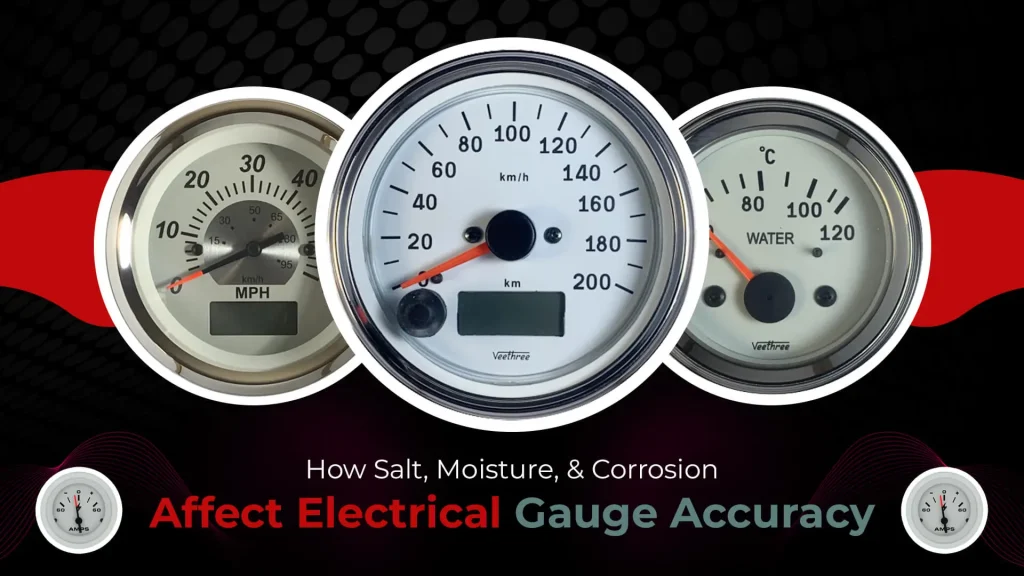
First the fuel gauge sits a bit higher than usual. Then the temperature gauge starts wandering when the engine bay gets hot. Then one wet weekend later, the oil pressure gauge looks nervous for no real reason. Most people blame the gauge itself. Sometimes they’re right. A lot of the time, the real trouble is sitting in the wiring, the ground, or the sender.
For VeeThree buyers, that matters. Veethree NZ sells electronic gauges, replacement gauges, and senders and sensors for marine and industrial use, and their own site keeps coming back to one simple truth: gauge performance depends on matched parts, clean connections, and components built for marine conditions. They also note compatibility across different resistance curves in many units, which is a big deal when you want readings that stay honest.
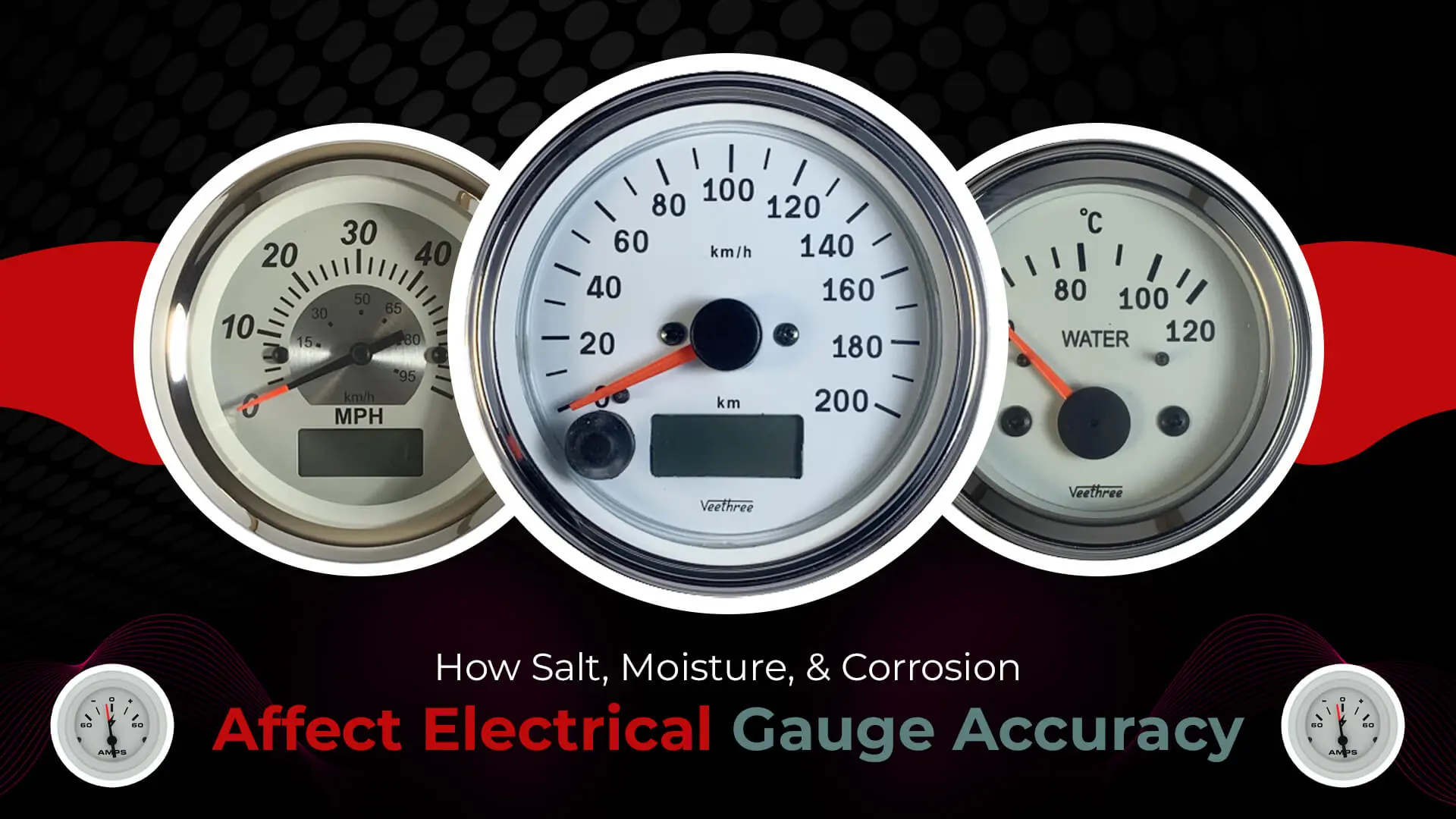
Table of Contents
- Introduction
- Why Electrical Gauge Accuracy drops so easily
- Salt corrosion on boat wiring is worse than most people think
- Moisture in electrical gauges creates sneaky problems
- Corroded gauge terminals do not need to look terrible to read badly
- Grounds and voltage drop quietly wreck Electrical Gauge Accuracy
- The sender matters more than most people realise
- What this looks like in real life
- How to protect Electrical Gauge Accuracy
- Why VeeThree parts make sense here
- Final word
- FAQs
Why Electrical Gauge Accuracy drops so easily
A gauge system is only as good as the full chain behind it. That means the gauge, the sender, the power feed, the ground, the terminal quality, and the condition of the connector seals. VeeThree says it plainly in its own marine guidance: the best gauge is only as good as its sender connection, and loose or corroded connections can lead to inaccurate readings or outright failure.
That lines up with what the wider electrical world says too. TE Connectivity explains that contact surfaces need to resist corrosion and other nonconductive films to keep interface resistance low. Once resistance starts creeping up where two metal parts meet, your signal quality stops being clean. That is bad news for electrical gauge troubleshooting, especially when the problem comes and goes.
Salt corrosion on boat wiring is worse than most people think
Salt is brutal because it hangs around. It settles on terminals, sits inside connectors, and keeps working even when everything looks dry on the surface. FEMA notes that ocean salts accumulate on metal surfaces and speed up electrochemical corrosion in coastal areas. An API standard also warns that galvanic action can accelerate fast in a salty atmosphere when moisture is present, especially when different metals are involved.
That is why marine gauge accuracy can look fine one month and then go sideways after a few rough trips, washdowns, or humid weeks at the mooring. Salt does not need a dramatic failure to cause trouble. Sometimes it just builds enough resistance to make a sender signal look wrong, or enough corrosion to turn a clean earth into a lazy one.
Moisture in electrical gauges creates sneaky problems
Moisture is annoying because it does two jobs at once. It helps corrosion grow on metal parts, and it can also affect insulation. A peer reviewed review in IEEE Open Journal of Device Packaging describes moisture intrusion causing corrosion over time and increasing the resistance of electrical conductors. Separately, an ACS publication notes that trapped moisture can lower the electrical resistance of insulating films enough to create unwanted paths for current.
Dampness can make one part of the circuit resist too much and another part leak when it should not. That is exactly how you end up with boat gauge problems that feel random. The needle flicks. The reading drifts. The dash behaves differently in the morning than it does after a long run. You start doubting everything, including yourself. Fair enough.
Corroded gauge terminals do not need to look terrible to read badly
This catches people out all the time. A terminal can look only “a bit crusty” and still be enough to throw off a reading. Rockwell Automation notes that corrosion rates go up in high moisture environments such as humidity and condensation. TE also stresses the importance of sealed connectors, grommets, and fluid resistant barriers in harsh environments because contamination at the interface is exactly what ruins reliability.
That is why the small stuff matters. A connector half clipped in. A ring terminal with white fuzz around it. A crimp that looked fine last season. A sender post with just enough grime to add resistance. None of that feels dramatic, but it is often the beginning of why boat gauges read wrong.
Grounds and voltage drop quietly wreck Electrical Gauge Accuracy
This is the bit people skip because it is not exciting.
VDO’s electric gauge instructions say dedicated grounding is required on some installations to ensure gauge accuracy and stop erratic readings. KUS says sender grounds need to be properly tied to a common ground or battery negative. AutoMeter also warns against excess voltage drop and tells installers to make sure the unit has a good ground.
So, if your voltage drop in marine wiring is up, or your ground path is tired, your gauge can still power on and still lie to you. That is what makes this stuff frustrating. The dash lights up, so you assume the circuit is healthy. It is not. A weak feed or bad ground is enough to turn a decent gauge into a bad witness.
The sender matters more than most people realise
A lot of “bad gauge” complaints are really gauge sender mismatch. Veethree’s NZ site talks about compatibility with European and American resistance curves, and their fuel sender listings show exactly how different those curves can be, including 0 to 30 ohms, 5 to 90 ohms, 75 to 10 ohms, and more. If the gauge and sender do not speak the same language, the reading is off before corrosion even enters the chat.
This is where matched parts save headaches. VeeThree sells matched marine senders and sensors, and some of their reed switch fuel senders use stainless steel bodies and are described as having longer life than resistive card senders that sit directly exposed to fuel. That is a practical upgrade when you are chasing stable fuel sender corrosion performance over time, not just a quick fix for today.
What this looks like in real life
Usually, it is not one massive failure. It is a stack of small things.
A boat sits for a while. Salt hangs around the dash. Humid air gets into a connector. One terminal starts building corrosion. The ground is still connected, just not well. The sender is old. The wiring has a bit of tug on it. Suddenly your electrical gauge accuracy is off enough to be annoying, but not bad enough to fail an obvious bench test.
That is why these issues drag on. They sit in the grey zone. The system still works, just badly.
How to protect Electrical Gauge Accuracy
Here is the simple version.
- Check every connection first. Tight terminals matter. Clean terminals matter more than people admit. VeeThree specifically recommends keeping terminals tight, corrosion free, and protected from moisture.
- Fix the ground before you replace the gauge. Good grounding is directly tied to stable readings in VDO, KUS, and AutoMeter guidance.
- Look for sealed parts. TE points to seals and grommets as critical contamination barriers in harsh environments. VeeThree also highlights corrosion resistant gauges and water sealing as things worth looking for in marine sensors.
- Match the sender to the gauge. Resistance curve mismatch creates bad readings even in a clean system.
- Stop treating salt as “just cosmetic”. In coastal and marine use, salt speeds corrosion and keeps attacking the weak spots in your wiring and connectors.
Why VeeThree parts make sense here
VeeThree NZ is already set up around the way these systems actually work. They stock electronic gauges, replacement gauges, and senders and sensors locally, and their marine content leans hard into matched pairings, corrosion aware installs, and components built for rougher conditions. If you are replacing a gauge after months of bad readings, it makes more sense to sort the sender, the wiring, and the connector condition at the same time, not just swap the dial and hope for the best.
Final word
Bad readings waste time. They also chip away at trust. Once a gauge lies to you a few times, every trip feels a bit second hand.
So do not wait for a full failure. If your dash has started doing weird little things, take it seriously now. Check the grounds. Clean the terminals. Look for salt creep. Make sure the sender curve matches. Then replace tired parts with properly matched marine gauges, senders, and sensors that are actually built for the job.
That is how you get real Electrical Gauge Accuracy back. Not by guessing. By fixing the whole chain.
FAQs