- Free shipping for NZ Customers. All items are available in NZ warehouse
- +64 (0) 212576146
- [email protected]

Vessel Instrumentation Guide: Starwhite Gauges vs Eclipse Gauges

Replacement Gauges and Senders in New Zealand: What to Measure Before You Buy
February 27, 2026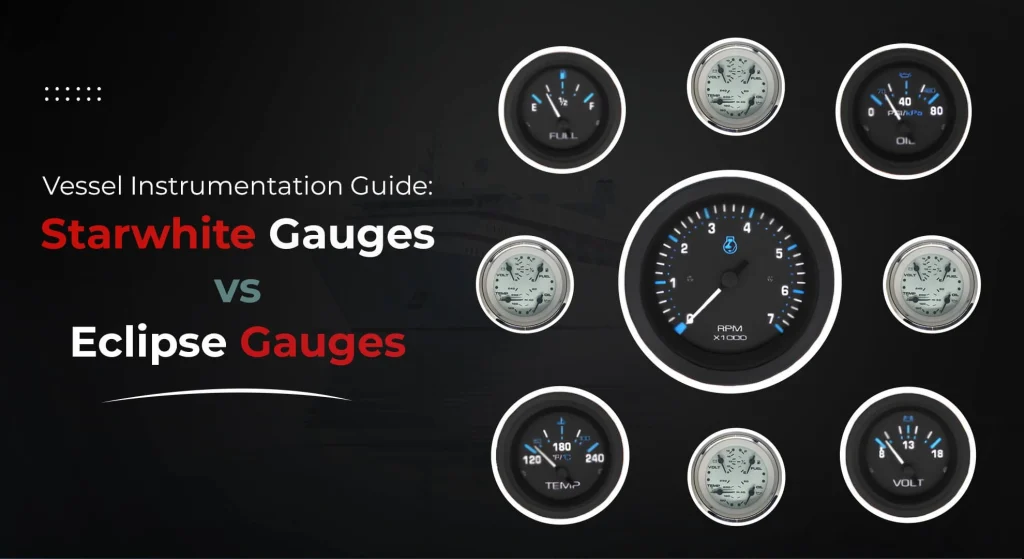
Last summer I found myself squinting at my own boat’s dashboard under bright noon sun, trying to read a glare-prone Starwhite-faced fuel gauge. It struck me that the debate of white versus black gauge faces isn’t just cosmetic – it’s about safety, confidence, and even style.
I remember helping a mate who ordered Eclipse gauges without realizing his wooden dash and brass hardware suddenly looked mismatched. These stories aren’t rare. When you spend thousands on a boat, the instrument cluster is more than filler; it’s your cockpit’s control center. So let’s talk honestly about picking Starwhite (white-dial) or Eclipse (black-dial) gauges – and when one might truly make sense over the other.

Style and Readability: What’s the Difference?
Choosing between Starwhite and Eclipse starts with appearance, but there’s more to it. Starwhite gauges have a clean, white dial and usually a polished chrome bezel. The idea is “clarity and accuracy” – the bright face makes numbers pop in mixed light.
In contrast, Eclipse gauges sport a black dial with white/blue graphics (think sleek modern look). Eclipse’s low-profile bezels and domed, anti-fog lenses are designed to shed water and resist scratching, giving you a contemporary dash that stays readable even in spray.
Starwhite fuel gauge (white dial, chrome bezel) – easy to read and classic in style. While both types are built tough for boats, the visual impact is opposite. White faces reflect light and feel traditional; black faces recede into the dash and look high-tech. From the brand’s side, Starwhite is “for those who value clarity” and Eclipse is pitched as “contemporary” and modern.
What I’ve seen: Boaters often choose Starwhite gauges for classic or lightly sunlit cockpits, where the bright dial stands out. Eclipse gauges fit newer consoles or tinted panels, blending a modern, minimalist vibe. Personal preference plays a part: one mate swears by the “authentic” feel of Starwhite’s white needles, while another wouldn’t have anything but Eclipse’s black style on his sleek speedboat.
Day vs Night Visibility: Lighting and Contrast
One honest insight: White faces can wash out under certain lights. In bright sun, a broad white background sometimes causes glare or a “washed-out” look, making the needle harder to see. Conversely, a black dial with crisp white and blue markings (like Eclipse’s) often yields higher contrast, especially at night with backlighting. This is why many aircraft and performance cars use black faces – they reduce glare.
That said, Starwhite gauges in new zealand come with illumination too. Their sapphire-white faces light up clearly after dark. If anything, their high-contrast numbers on white can be astonishingly bright at night. A pro tip I learned: wire the gauge’s illumination to switched power (like ignition). The tiny heat from the bulb actually helps keep the lens clear of moisture. One forum veteran even joked that if your gauge ever fogs, a little dash heater (via backlight) usually fixes it. Eclipse gauges’ anti-fog lenses help mitigate condensation as well, but wiring trick applies equally to any gauge.
Practical example: I installed white-face gauges on a friend’s fishing boat, only to find the early-morning sun hitting them hard. We added an adjustable shade and the preset LED lighting, which solved it. By contrast, on a midday sail on a choppy lake, I noticed his black Eclipse gauges had much crisper legibility – the needle and numbers “popped” against the dark face. So, which is easier? It depends on your helm conditions and personal eyesight. The key is to test on your next outing, observe your current gauges in both sunlight and at night. Your experience will guide whether white or black suits you.
Durability and Marine Readiness
Whatever color you choose, both Starwhite and Eclipse gauges in new zealand are built for boat life. They’re made in the USA and come with features like scratch-resistant glass and corrosion-resistant bezels. In practice, neither series has a reliability edge; both hold up in salt spray and engine heat. In fact, they often share internals (same meter movement and electronics), so performance is similar.
One nuance: Eclipse gauges have domed, anti-fog glass. If your boat takes a lot of spray or you live in humid weather, that might give them a slight advantage. Starwhite ones don’t advertise anti-fog, so in our boat clinic I always wire their backlight as mentioned to keep the lens clear. Fogging isn’t common, but it’s a true pain when it happens – a modern lens can usually handle it, or a hot dash. On a Welly harbour trip, I noticed a Starwhite voltmeter slightly mist up – turned out the backlight was off. Flicked it on, and the clear shot of warmth cleared the fog. Eclipse gauges’ design often repels water faster, but again, proper power wiring is the secret.
Installation and Fit: Cutouts, Senders, and Matching
Here’s where a lot of people get it wrong: in terms of fit and function, Starwhite and Eclipse gauges are interchangeable. Both series use the same standard sizes: 52 mm cutouts for the small fuel/oil/temp gauges, and 86 mm for speedometers and tachometers. The mounting hardware and electrical hookup are identical. So if you like the look of Starwhite for your fuel gauge, you can still pick an Eclipse tachometer later, and they’ll fit the dash hole just fine.
Sending units (fuel float, oil sender, etc.) are the same for either series. Both Starwhite and Eclipse fuel gauges expect a 240–33 Ω sender curve. Both oil pressure gauges expect 0–80 psi with the matching 1/8″ NPT sender. In fact, the Starwhite fuel gauge listing explicitly says it has a matching sender option, just like the Eclipse version. If you buy a gauge plus sender kit, you’re getting the right curve no matter which face you chose.
Heads-up: The one physical difference is bezel style: Starwhite typically has a thicker chrome or stainless bezel (like a small trim ring), whereas Eclipse has a “low-profile” bezel that’s nearly flush. This can slightly change the depth behind the dash – just give yourself a few mm clearance. I’ve seen dashboards where a thicker chrome bezel didn’t quite sit flat against a panel. Always measure if your dash is ultra-tight, but in 99% of cases the fit is plug-and-play.
Mixing It Up: Style Consistency vs Function
A common team mistake is “let’s just buy what’s cheapest or looks cool” and end up with a mixed dash. We did it once: a project boat had an Eclipse tach and speedo, but Starwhite fuel, temp, volt gauges. The result? It looked like someone raided two different boat shops and glued them together. It worked, but the dash screamed “I was improvised.” My rule now: stick to one series for a cohesive look, unless you have a reason to mix. It’s like wearing two different shoe styles – they might match, but do they really? Veethree even emphasizes picking one series, so your brain reads the dash as one system.
That said, mixing series isn’t disastrous. If your budget is tight, you could install a single-starwhite tach now and add eclipse tanks later. Just beware the psychological effect: your crew might momentarily ask “which gauge is which” if colors and fonts differ. And if you do mix, try to keep all backlight colors the same to avoid one gauge glowing green and another red. Fortunately both Starwhite and Eclipse use neutral lighting (white or blue pointers) – no weird neon surprises.
Genuine Advice & Trade-offs
- Contrarian tip: Many blogs tout “white gauges are easier to read.” In reality, black-face gauges often win night-time readability because they don’t “wash out”. I once chose a white-star gauge for a truck thinking it’d be clearer – at night I had to dial up the dash lights to avoid glare. Not a deal-breaker, but worth knowing.
- My experience: On a retrofitted launch, we went with Starwhite for its classic look. It was beautiful by day, but at dusk we noticed the thick chrome bezels caught reflections. We eventually added small sunshades above the dash lights. With Eclipse, the flush bezels and anti-glare lens would’ve eased that fuss – but then the boat wouldn’t have its “authentic” look.
- Trade-off: If your boat is an older wooden runabout, white dials with chrome bezels (Starwhite) can match brass switchplates beautifully. However, on a modern fibreglass cruiser, I prefer black (Eclipse) to avoid that dated contrast. There’s no “wrong” choice – it’s like picking a paint colour – but do consider your boat’s overall design language.
- What teams overlook: We often focus on visuals, but don’t forget user psychology. A wildly colorful gauge cluster (red fuel, green temp, etc.) might “look fun,” but it can confuse guests. Both Starwhite and Eclipse series use consistent pointer colors (typically white or blue) and lighting. Once you choose a family, keep everything uniform.
- Truth: Neither Starwhite nor Eclipse is magically more accurate. They’re built to the same VDO/Stewart-Warner specs. Don’t be swayed by marketing terminology like “precision” on one and “sleek” on the other. The real difference is what you feel at the helm – clarity, confidence, and if you like the style after staring at it for 10 hours a week.
Conclusion & Recommendation
If I had to sum it up: Starwhite gauges (white dials, chrome/silver trim) give you a classic, high contrast look that some eyes favor in daylight. Eclipse gauges (black dials, low-profile trim) deliver a modern, minimalistic style with features like anti-fog glass that shine in tough conditions. Performance-wise, they share the same guts and both are more than rugged enough for New Zealand waters.
So which to pick? Gauge face color is a personal choice – match it to your boat’s aesthetic. But beyond style, think practically: consider your typical light conditions and how each reads, and don’t forget the installation details (sending units and cutouts are the same). In the end, go with the set that feels right for your boat’s vibe and that you feel comfortable reading, day or night.
FAQs: