- Free shipping for NZ Customers. All items are available in NZ warehouse
- +64 (0) 212576146
- [email protected]

Electrical Gauges for Marine Dashboards: Wiring, Senders, and Common Accuracy Mistakes

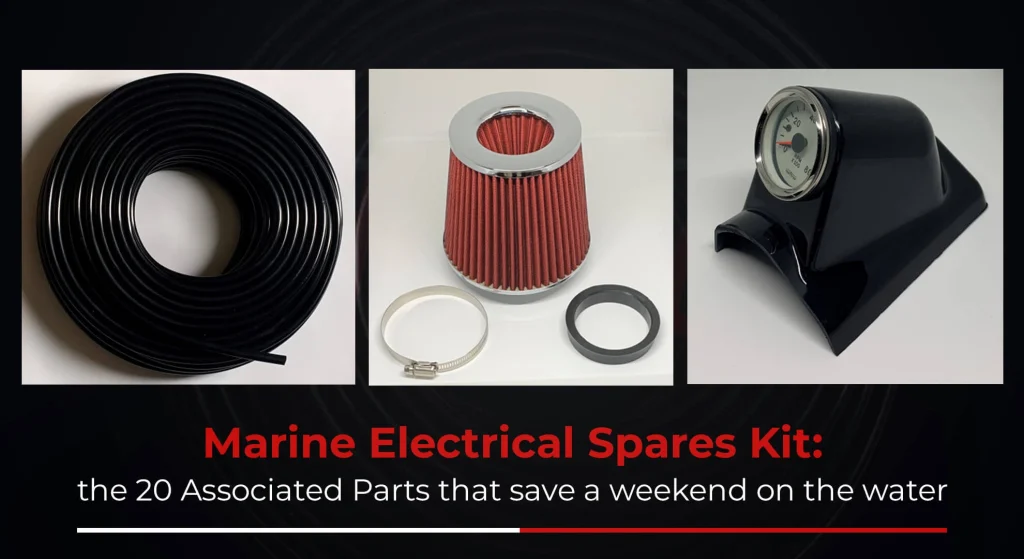
Marine Electrical Spares Kit: the 20 Associated Parts that save a weekend on the water
January 30, 2026
What Kind of Mechanical Gauges Matter Most for NZ Boating Conditions
February 13, 2026
If you run a boat in New Zealand, your dash lives in a tough place. Salt, vibration, changing loads, and long days on the water all push your instruments hard. Reliable electrical gauges help you see problems early and keep trips simple and calm.
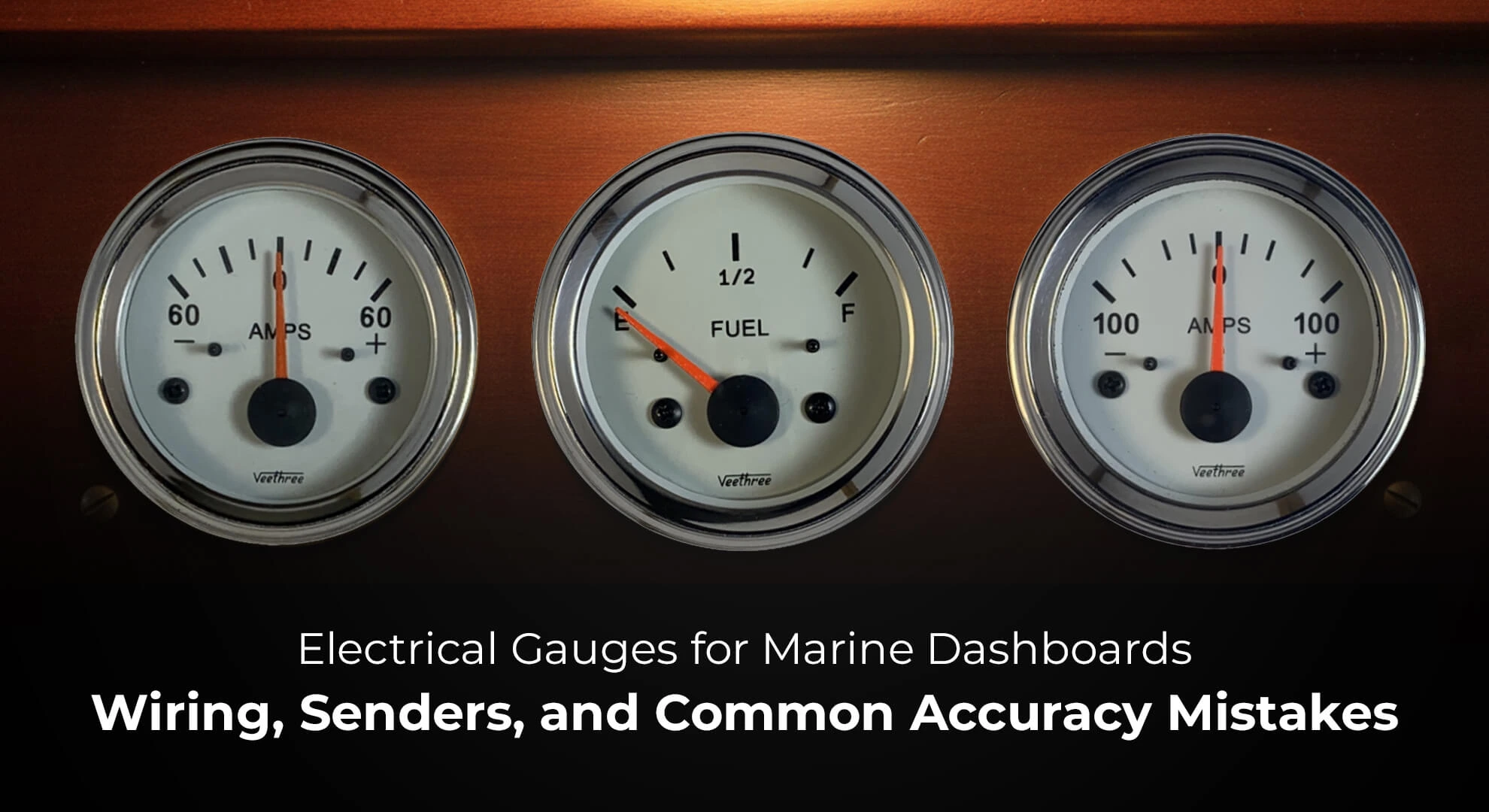
Veethree New Zealand supplies a wide range of marine electrical gauges, senders, and complete gauge sets built for marine use, including local stock for common fuel and engine monitoring layouts.
This guide walks you through:
- What Veethree offers in electrical gauges for marine dashboards
- How 240-to-33-ohm fuel gauges and senders work together
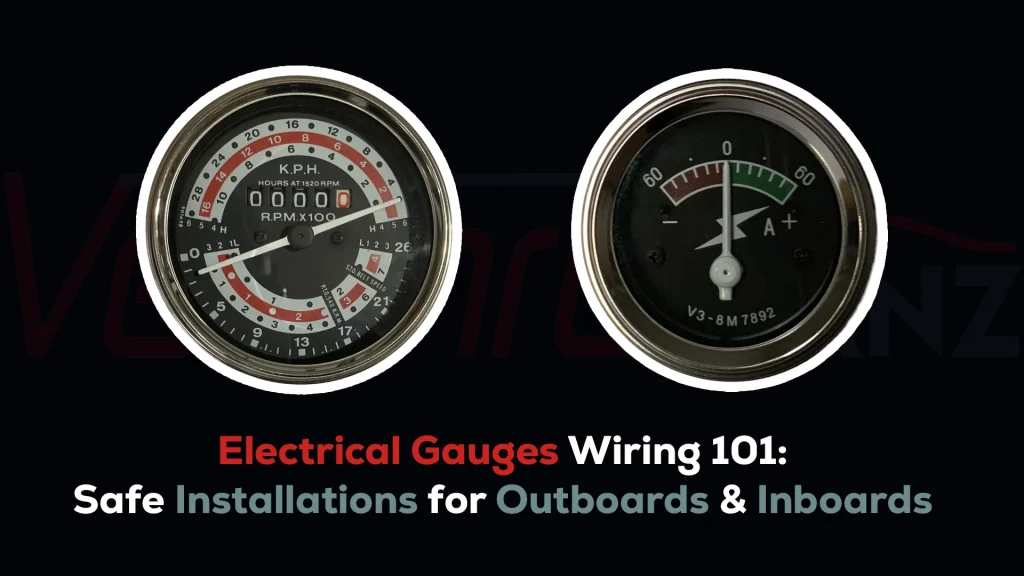
- How to approach electrical gauges wiring for outboards and inboards
- Common accuracy mistakes and how to avoid them
Why marine dashboards rely on electrical gauges in New Zealand
Recreational boating is a major pastime in Aotearoa. Recent Maritime NZ research estimates about 1.2 million New Zealanders own at least one vessel, with roughly 3.6 million privately owned recreational boats and around 221 million boating exposure hours over a 12-month period.
At the same time, marine electronics and sensors keep growing as a category. Global marine electronics revenue sits around 6.7 billion US dollars in 2024 and is forecast to almost double by 2034. Marine sensors also show steady growth, driven by demand for better monitoring and data offshore.
For you, that trend shows up in simple, practical ways:
- You expect your electrical gauges to be accurate and stable at sea.
- You want gauges that match standard senders and wiring on common engines.
- You need products that suit boat electrical gauges nz conditions, not just generic automotive parts.
Veethree focuses on marine grade instruments with corrosion resistant bezels, scratch resistant lenses, brass terminal connectors, and night illumination across many gauge families such as Black Premier, White Sterling, Arctic, Eclipse and more.
What Veethree offers in marine electrical gauges
Veethree New Zealand stocks individual instruments and matched gauge sets so you can build or refresh a full marine dashboard. Most panel layouts use 52mm electrical gauges for key engine functions such as fuel, oil pressure, water temperature, and battery voltage.
1. Engine and system monitoring with 52 mm form factor
Many Veethree instruments use the common 52 mm cut out. These 52mm electrical gauges keep your dash compact and consistent while still leaving space for larger speedometers and tachometers. You will see this size on:
- Fuel level gauges
- Oil pressure gauges
- Water temperature gauges
- Voltmeter gauges
Night illumination and perimeter lighting are standard on many models, so you can read values at a glance on night passages.
2. Battery health with a voltmeter gauge marine
Your charging system is easy to ignore until it fails. A dedicated voltmeter gauge marine lets you watch battery and alternator performance in real time. Veethree offers wide range of voltmeters in several styles designed for marine use with sealed lenses and corrosion resistant bezels.
On a simple dash you use the voltmeter to:
- Confirm that your engine alternator is charging.
- Spot low battery voltage before electronics shut down.
- Catch overcharge issues that can damage batteries.
3. Protecting the engine with an oil pressure electrical gauge
Loss of oil pressure is one of the most serious engine faults. An oil pressure electrical gauge gives you a live view of lubrication pressure and helps you shut down quickly if something goes wrong. Veethree supplies electrical oil pressure gauges and matching senders, including those bundled inside marine gauge sets.
On many diesels and petrol inboards you will use oil pressure together with engine temperature and tachometer speed to build a picture of engine load and health.
4. Cooling control with a water temperature electrical gauge
Overheating ruins trips and can cause expensive damage. A water temperature electrical gauge helps you spot blocked strainers, failing impellers, and restricted exhausts before they escalate. Veethree kits often include a 52 mm temperature gauge with a matching sender, set up for typical marine cooling ranges.
5. Fuel system visibility with a fuel level gauge 240 33 ohm
Fuel is the other obvious risk. Many Veethree marine fuel gauges use the common 240-to-33-ohm resistance curve. The fuel level gauge 240 33-ohm options in the catalogue include 12 volt and 24-volt models, different bezel and dial styles, and a standard 52 mm diameter.
How gauges and senders work together
The role of a marine fuel level sender 240 33 ohms
A fuel gauge only reads accurately if its sender matches the gauge resistance curve. American standard marine systems use 240 ohms at empty and 33 ohms at full, often called 240–33 ohm.
Veethree offers a dedicated marine fuel level sender 240 33 ohms, adjustable for tank depths from about 4 inches to 24 inches, with a standard SAE five-hole flange and marine grade construction for petrol, diesel, and biofuels.
You can also choose a universal fuel level sender 240 to 33 ohms that adjusts across 7 to 24 inch tank depths and works with 6, 12, and 24 volt gauges. When you match a fuel level gauge 240 33 ohm and marine fuel level sender 240 33 ohms from the same range, you:
- Keep the resistance curve aligned from empty to full.
- Use a sender designed for the same mounting pattern as the gauge expects.
- Reduce the chance of step like or jumpy readings that you often see when gauges and senders do not match.
KUS fuel level specialist Yale Huang explains the link between sender and gauge in simple terms:
“The signal output is how the sender in your tank and the gauge on your dashboard correspond with each other.”
That is why Veethree product pages for fuel gauges point you to matching Veethree senders in the same 240-to-33-ohm range.
Getting electrical gauges wiring for outboards and inboards right
Outboards and inboards use different looms and engine interfaces, but the core ideas behind electrical gauges wiring for outboards and inboards stay the same. You always need:
- A clean, fused feed from your battery or ignition switch to the gauge.
- A solid ground return for each gauge.
- A sender lead that runs from the sensor to the S terminal on the matching gauge.
- Backlighting power tied into your dash light circuit if you use night illumination.
For a fuel gauge and sender pair using the 240-to-33-ohm standard:
- Connect ignition feed to the gauge I or plus terminal through a fuse.
- Connect the gauge ground to a clean dash ground bus.
- Run a single sender wire from the gauge S terminal to the sender output stud.
- Ground the sender flange or ground terminal to the same dash ground bus.
When you wire electrical gauges on outboards, you often pick up power and sender signals from the engine harness or a dedicated engine interface. On inboards you may run more point-to-point wiring from the engine bay to the dash. In both cases Veethree recommends that you follow the wiring diagrams supplied with your engine and with the gauge or gauge set you install.
Marine How To, a respected independent technical site, notes that testing and wiring fuel senders is not complex:
“This is one of the easier tests you can conduct.”
That holds for most basic wiring checks as well, if you take your time and work methodically.
Common accuracy mistakes with boat electrical gauges nz
Many owners blame the gauge first. In practice, the most frequent faults sit in three places: the sender, the wiring, or the tank.
1. Gauge and sender resistance do not match
If you pair a 240-to-33-ohm sender with a gauge built for 10 to 180 ohms, you will see wrong readings at every level. This happens often when owners mix brands or buy parts on price alone.
To avoid this:
- Check the resistance curve on the Veethree gauge product page.
- Check the resistance curve on the sender product page.
- Confirm both specify 240 to 33 ohms before you wire them together.
2. Poor grounds and power feeds
Many “broken” gauges turn out to be fine. Common wiring issues include:
- No ground to the sender flange, so the gauge only ever reads full or empty.
- Shared, corroded grounds that move the reference point for several gauges at once.
- Ignition feed taken from a weak source, so voltage sags and gauges drift.
Simple steps that help:
- Run a dedicated ground bus behind the dash.
- Use ring terminals and stainless fixings, not loose push on joints, in wet areas.
- Protect joints with heat shrink and keep them away from high spray zones.
3. Tank shape and sender adjustment
Even with the right marine fuel level sender 240 33 ohms, the wrong mechanical setup can cause odd readings:
- Sender not adjusted to the actual tank depth (Veethree universal and marine senders are adjustable within set ranges).
- Tanks with complex shapes that hold more fuel in some parts than others.
- Baffles that block the float arm or sender body.
KUS engineering guidance stresses the need to match sender length and calibration to tank depth and shape for accurate readings.
4. Installation environment for marine electrical gauges
Dash mounted marine electrical gauges live in heat, spray, and UV. Over time, problems can come from:
- Salt creep into the connector area behind the panel.
- Water trapped behind the dash with no drain path.
- Vibration that slowly loosens spade connectors.
Veethree marine gauge families are built with anti-fog lenses, corrosion resistant bezels, and sealed illumination to cope with this environment, but they still rely on sound panel design and basic maintenance.
FAQ: